
Introduction
Every garden has that one awkward shady corner where nothing seems to settle in and thrive. Skimmia japonica earns its space there with quiet, steady reliability. This compact evergreen shrub stays green all year, throws off fragrant flowers in spring, and finishes winter with glossy red berries. This guide walks you through planting, soil, those berries, the best varieties, and the common problems that trip people up.
Here are the core facts up front. Japanese skimmia is a slow-growing, dense broadleaf evergreen, and it sits in the same family as citrus. It reaches about 2 to 7 feet (0.6 to 2.1 m) tall and 3 to 5 feet wide over many years. It's hardy in USDA zones 7a to 8b, which makes it a dependable pick for cooler, shadier spots.
Three questions trip people up the most with this plant, and this guide settles all three. First, the acidic soil question, since people assume skimmia needs it. Second, the male and female plant puzzle that decides whether you get berries at all. Third, real berry safety advice, plain and honest. You get clear answers you can act on today.
This shade shrub gives back across the whole year. You get flowers in spring. You get fragrant leaves on every single day. The buds turn colorful through autumn. Then come the winter berries when the rest of the garden has gone quiet. It works like a four-season shrub, not a one-season flower. That's why it shows up so often in north-facing and woodland-edge borders.
Skimmia Japonica At A Glance
Skimmia japonica goes by the name japanese skimmia at most plant shops. It is a rounded broadleaf evergreen shrub that keeps its glossy leaves all year. The plant comes from Japan, China, and nearby parts of East Asia. There it grows in dappled light under taller trees. Crush a leaf between your fingers and you get a faint citrus scent. That smell hints at its roots. This plant sits in the rutaceae family, the same group that gives us oranges and lemons.
The shrub stays compact and tidy with almost no fuss from you. Female plants carry clusters of bright red drupes through winter. Each berry is about 3/8 inch (1 cm) wide. The buds and spring flowers add a second season of interest. Deer tend to leave it alone, and bees work the small blooms in spring. These quick facts give you the shape of the plant before we get into the care numbers.
Plan around that mature size before you plant. Most shrubs reach 2 to 7 feet (0.6 to 2.1 m) tall and spread 3 to 5 feet (0.9 to 1.5 m) wide. They thrive in USDA zones 7a to 8b. The Royal Horticultural Society notes the species rarely tops 5 feet (1.5 m). Compact cultivars stay small at 16 to 28 inches (40 to 70 cm). So the variety you pick matters as much as the species name on the label.
Skimmia grows at a slow rate, so set your expectations. Think of it like a hedge that takes several years to knit together, not a vine that fills a fence in one season. The smart move is to buy a plant close to the size you want now. You save years of waiting, and you get the full look from the day you plant it.
Skimmias are one of the best low-maintenance, slow-growing, hardy evergreen shrubs for shadier borders.
Where And How To Plant Skimmia
A damp north-facing back corner where the lawn meets the woodland edge now holds a glossy evergreen patch I can see from the kitchen window. A male 'Rubella' and a female 'Nymans' went in a few autumns ago, and they slowly knitted together into one solid clump. Before that, the spot sat bare and gloomy. Every bedding plant I tried there sulked, faded, and gave up by midsummer.
So where to plant skimmia japonica comes down to one thing. This shrub wants shade and shelter, not a sunny open bed. Aim for partial shade to deep shade, like a north-facing wall, a sheltered corner, or the dappled light along a woodland edge. A little morning sun is fine, but hot afternoon sun is the enemy.
Get the light wrong and you get leaf scorch, where the foliage turns pale, then dry and crispy at the edges. The one common exception is S. x confusa 'Kew Green', which copes with more sun as long as the soil never dries out. Everywhere else, the safe rule is simple. Shelter the plant from baking afternoon sun and steer clear of dry, exposed spots.
UK growers lean hard on shade, while US gardeners in zones 7a to 8b can allow a touch more morning sun without trouble. Either way, give each plant room to spread to a mature width of 3 to 5 feet (0.9 to 1.5 m). Below are the steps for planting skimmia so it settles in fast and stays happy for years.
Pick a sheltered position in partial to deep shade with moist, well-drained soil, avoiding hot afternoon sun that scorches the leaves.
Dig in plenty of organic matter such as leaf mould or compost so the soil holds moisture yet still drains freely.
Set the root ball level with the surrounding soil, then firm the soil gently around the roots to remove air pockets.
Water the plant in well, then spread a mulch of bark or compost around the base to lock in moisture and suppress weeds.
If you want winter berries, plant a male skimmia nearby to pollinate your female plants, or choose a self-fertile type.
Skip garden-centre female plants that are forced and pot-bound under a heavy crop of berries, as they often establish poorly and struggle to settle into the ground.
Once it settles, skimmia shrugs off conditions that defeat most shrubs. It puts up with urban pollution and dry shade. That is why it earns a spot in courtyards, beside a shaded doorway, or in the awkward strips of ground beside a north wall or fence. Plant it where little else will grow, and it pays you back.
Soil, Watering And Feeding
Some growing notes will tell you skimmia needs acidic or heath soil. That advice is wrong, and following it wastes your money on ericaceous soil the plant does not want. The RHS and NC State Extension both agree on this point, so trust them over the older garden lore.
Good skimmia soil is rich, moist, and well-drained, with plenty of organic matter in it. NC State lists acidic to neutral ground for it. The plant can even cope with a pH up to about 8.0, which counts as alkaline. Mix in leaf mould, compost, or well-rotted manure before you plant. That gives the roots a bed that holds moisture.
Watering skimmia is simple once you split it into two phases. Treat the first two years as the settling-in time. Water during dry spells while the roots spread out. After that the plant looks after itself. The RHS says settled skimmias cope well with dry soil, so you only step in during a long drought.
Soil Type And pH
- Reaction: Skimmia grows well in acidic to neutral soil and tolerates a pH up to around 8.0, so it does not need ericaceous compost.
- Texture: Rich, well-drained but moisture-retentive soil suits it best, ideally improved with leaf mould, compost, or well-rotted manure.
- Avoid: Solid chalk and waterlogged ground are the main soils to avoid, as poor drainage and very thin alkaline sites cause stress.
Watering Through The Year
- First two years: Water newly planted skimmias during dry spells while the roots establish, keeping the soil moist but never soggy.
- Established plants: Once settled, skimmias are fairly drought tolerant and usually need extra water only in prolonged dry weather.
- Containers: Potted skimmias dry out faster than those in the ground, so check the compost regularly and water before it dries out.
Feeding And Mulching
- Feeding: Established skimmias in borders need little or no regular feeding, so heavy fertiliser is usually unnecessary and can do more harm than good.
- Mulch: An annual spring mulch of compost or bark conserves moisture, feeds the soil slowly, and keeps the shallow roots cool.
- Yellow leaves: Treat yellowing as a watering or sun problem first, since iron treatments rarely help a plant that is not acid-loving.
Drainage And Position
- Drainage: Free-draining soil prevents the roots sitting in water over winter, which is a common cause of decline in heavy clay.
- Shelter: A position out of drying winds and harsh afternoon sun keeps the soil moist for longer and reduces leaf scorch.
- Improvement: Working organic matter into the planting area before planting gives the roots a moisture-holding zone to settle into.
Skimmias do not need to be planted in acidic soils or ericaceous compost. They are not acid loving plants like rhododendrons. Yellowing of the leaves is usually caused by excessive dryness, not by alkalinity induced chlorosis.
The myth has a knock-on effect worth knowing. Skimmia is not acid-loving, so iron treatments like sequestered iron will not fix yellow leaves. The RHS pins that yellowing on dry soil or too much sun. Check your watering and the plant's spot before you reach for any feed.
Feeding skimmia is the easiest part of the whole job. Established plants in a border need little or no feeding, and heavy fertiliser can do more harm than good. A single spring mulch of compost or bark covers their needs. It keeps the shallow roots cool and holds moisture in the soil.
Male And Female Plants For Berries
Those red winter berries are the reason most people buy this shrub, but they only show up if you get one detail right. Skimmia is dioecious, which means each plant is either male or female, never both. A female sets the skimmia berries, and a male supplies the pollen that makes them form.
Get the male and female skimmia pairing wrong and you end up with a healthy bush that never fruits. So you need at least one plant of each sex growing close to each other. One male can pollinate several females. The recommended ratio is one male for every six female shrubs.
Telling the two apart in spring is simple once you know the trick. Males put on the bigger, showier, more scented flower display, while females flower more modestly. Then in winter the females carry the red drupes about 3/8 inch (1 cm) wide. So the berries themselves confirm a female every time.
Short on space for two plants? There is a clean fix. The subspecies reevesiana carries both sexes in one plant. So it fruits on its own. A single bush sets berries with no separate male partner. This self-fertile skimmia is the smart pick for a tiny garden or a single pot by the door.
One last warning that catches a lot of buyers out. A lone female bought in full berry looks like a sure thing, but pollination still has to happen for next year's crop. Without a male close enough for bees and other insects to bridge the gap, that same plant often fails to fruit again in later seasons.
Best Skimmia Varieties To Grow
A male 'Rubella' lit up the damp back corner of my garden with deep red winter buds, the kind of color nothing else there held through the cold months. I planted it by the woodland edge beside a female 'Nymans' that carried a fat crop of red berries. The buds caught the low light on grey afternoons, and the whole corner came alive when the rest of the garden had gone quiet.
That mix shows why the best skimmia varieties earn their place for more than berries alone. Some plants give you winter color from their buds, some give you fruit, and a few do both the pollinating and the show at once. Pick the ones that match what you want from the spot.
The cultivars below cover both jobs. I noted the sex of each plant so you can match a male to your females. I also flagged the ones that hold the RHS Award of Garden Merit, which marks a proven garden plant. Compact forms stay around 16 to 28 inches (40 to 70 cm), while the species can reach about 5 feet (1.5 m).
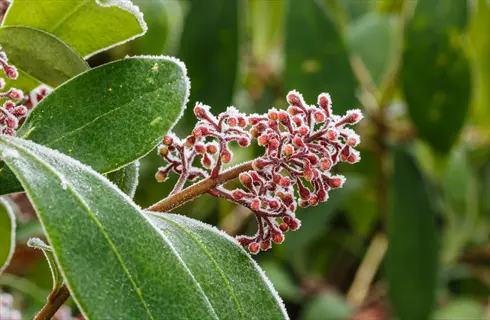
Skimmia Rubella (Male)
- Sex: A male cultivar that acts as a reliable pollinator for nearby female skimmias, so it earns its place in any berrying display.
- Winter buds: Deep red flower buds hold through autumn and winter, giving strong seasonal color long before the creamy flowers open in spring.
- Award: It is a popular pick, and the fragrant males such as 'Fragrans' carry the RHS Award of Garden Merit for reliability.
- Size: A compact, rounded shrub that stays manageable, generally well within the species range of up to about 5 feet (1.5 m).
- Fragrance: The opening flowers are scented, adding spring perfume to a shaded border or container near a doorway.
- Use: A favorite for winter pots and shaded beds where its colored buds provide structure and interest.
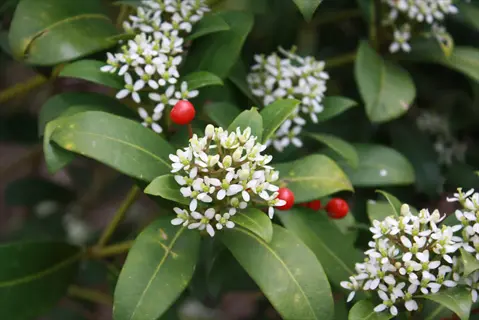
Skimmia Nymans (Female)
- Sex: A female cultivar grown for its generous crop of bright red berries when a male pollinator grows nearby.
- Award: 'Nymans' holds the RHS Award of Garden Merit, marking it as a dependable, well-performing garden plant.
- Berries: It tends to spread and fruit freely, carrying glossy red drupes that last well into winter for color and wildlife.
- Flowers: Modest white spring flowers precede the berries, in keeping with the quieter floral display typical of female plants.
- Size: A medium, spreading evergreen that fits a shaded border within the usual skimmia size range.
- Pairing: Plant it with a male such as 'Rubella' to ensure a reliable berry display year after year.
Skimmia Kew Green (Male)
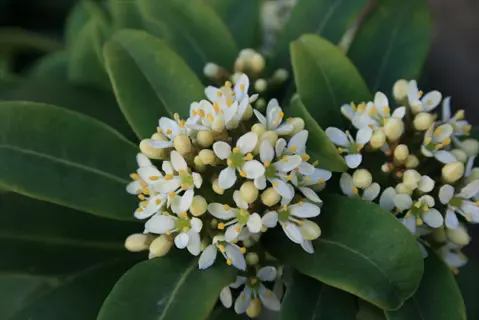
- Sex: A male form, often listed as Skimmia x confusa 'Kew Green', valued as a pollinator and for its fragrant green-white flowers.
- Sun tolerance: Unusually for skimmia, 'Kew Green' tolerates a sunnier spot provided the soil is not excessively dry.
- Flowers: It produces conical heads of scented green-white flowers in spring that attract bees and other pollinators.
- Size: A neat, dome-shaped evergreen that stays compact and tidy with little intervention.
- Foliage: Glossy aromatic leaves give year-round structure in shaded and part-shaded planting.
- Use: A strong choice where a little more light reaches the border and a male pollinator is needed.
Skimmia Subspecies Reevesiana (Self-Fertile)
- Sex: This hermaphrodite subspecies is self-fruiting, so a single plant can set berries without a separate male partner.
- Small gardens: Its self-fertile habit makes it ideal where there is only room for one skimmia, such as a small bed or pot.
- Berries: It carries red fruits reliably on its own, giving winter color without the usual male-female pairing.
- Size: A compact, low grower, well suited to containers and the front of shaded borders.
- Habit: Dense evergreen foliage gives a tidy, rounded shape that needs little pruning.
- Use: The simplest option for gardeners who want berries from just one plant.
Skimmia Veitchii (Female)
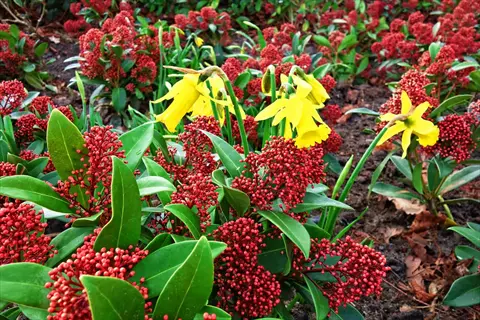
- Sex: A vigorous female cultivar, sometimes sold as 'Foremanii', grown for its strong crop of large red berries.
- Berries: It produces big, showy clusters of red drupes that make a bold winter display when pollinated by a male.
- Vigour: A robust, spreading grower that fills space well in a shaded border over several years.
- Flowers: White spring flowers open before the berries form, typical of the quieter female floral display.
- Size: One of the larger berrying females, sitting toward the upper end of the usual skimmia size range.
- Pairing: Grow it near a male such as 'Rubella' or 'Kew Green' for the heaviest berry set.
Pairing is simple once you know the parts. Grow a male such as 'Rubella', 'Kew Green', or 'Fragrans' near your berrying females like 'Nymans' or 'Veitchii', and you get fruit. One male can pollinate several of your females, so you do not need a one-to-one match in your border.
Tight on space? Go for a self-fertile skimmia instead. The subspecies reevesiana and the cultivar 'Obsession' set berries on their own. One shrub does the whole job, no male needed. For reliable AGM skimmia choices, 'Fragrans', 'Nymans', and 'Rubella' are the names worth tracking down.
Pruning, Problems And Safety
Most skimmia problems trace back to the wrong spot, not to bugs or disease. This shrub has no serious pests, shrugs off pollution, and deer leave it alone. Get the site right and you spend more time enjoying it than fixing it.
Pruning is the easy part. The plant grows slowly and stays tidy on its own, so pruning skimmia means light shaping after flowering rather than shearing it like a hedge. Cut back a female too hard and you snip off the very buds that become winter berries.
A few issues do show up. Spider mites arrive in warm, dry spells, leaf edges turn pale when the plant goes thirsty, and the bright fruit raises a fair safety question. Here is how to handle each one without overreacting.
Pruning Lightly
- When: Prune with a light hand and only after flowering, since skimmia is a tidy plant that needs no more than minor shaping.
- Females: Cutting back a female removes its developing berries, so trim with care if you want the winter fruit display.
- Renovation: Hard renovation of old, neglected plants seldom succeeds, so it is better to replace a failing shrub than make deep cuts into it.
Pests To Watch
- Spider mites: These can appear in warm, dry conditions, causing fine mottling on the leaves that worsens if the plant is stressed.
- Scale and aphids: Horse chestnut scale and aphids are occasional visitors and can usually be managed with simple measures such as insecticidal soap.
- Overall: Skimmia has no serious insect or disease problems, so good siting and moisture prevent most trouble before it starts.
Yellow Leaves And Stress
- Cause: Yellowing is usually caused by excessive dryness or too much sun rather than soil acidity, according to the RHS.
- Fix: Improve watering and shade first, since iron treatments rarely help a plant that is not acid-loving.
- Drainage: Waterlogged roots in winter can also stress the plant, so free-draining soil keeps the foliage healthier.
Berry Safety
- Severity: NC State Extension rates the fruit as poison severity medium, with nausea in small amounts and serious effects in large quantities.
- Conflicting reports: The RHS describes only a mild stomach upset, so sources disagree on how severe the fruit is.
- Safe approach: Because reports conflict, treat the bright red berries as poisonous and keep curious children and pets from eating them.
Treat skimmia berries as poisonous because sourced reports range from mild stomach upset to serious effects in quantity. If a child or pet eats them, contact a vet, doctor, or poison line such as the ASPCA Animal Poison Control Center on 888-426-4435.
So treat the poisonous berries as off limits. Do that and you remove the only real worry this plant brings. The fruit looks tempting. The sources still disagree on how harmful it is, and that gap is reason enough to keep kids and pets clear.
For everything else, watch the leaves and act early. Yellow leaves usually mean the roots ran dry or the sun got too strong, not that your soil needs acid. Water, shade, and good drainage fix most of it before it ever turns into a real problem.
Year-Round Interest And Companions
I stood at the kitchen window on a grey midwinter morning, coffee in hand. Out in the damp back corner by the woodland edge, the red 'Rubella' buds and the female 'Nymans' berries glowed. Around them the branches were bare and the leaf litter was brown. Everything else had given up for the year. That one lit corner pulled the whole garden together.
This is the year-round interest that makes skimmia worth your space. It holds color across all four seasons, which is rare for a shade plant. Your north-facing border can look flat and tired from autumn onward. A few well-placed skimmias keep it alive. They give you a structural backbone in shaded courtyards and winter container displays.
The seasonal rhythm is easy to follow once you know what to watch for. Fragrant creamy-white flowers open in spring and the glossy evergreen foliage stays put all year. Colorful buds form through autumn. Then winter berries on pollinated females carry the show through the coldest months.
Spring
Fragrant creamy-white flowers open, scenting shaded borders and drawing bees, while fresh growth firms up the evergreen frame.
Summer
Glossy aromatic foliage gives cool structure in shade; keep new and potted plants watered through any dry spells.
Autumn
Colorful flower buds form and deepen, especially red buds on male cultivars such as 'Rubella', setting up the winter show.
Winter
Red berries on pollinated females and bright buds on males carry the display through the coldest, barest months of the year.
Good companion planting starts with plants that want the same things skimmia does. Pick shade and moisture lovers and your whole bed thrives together. I plant mine with rhododendrons, camellias, and azaleas for bigger spring color up top. Ferns and woodland perennials soften the ground layer for you. They also hide the bare stems near the base.
Skimmia earns its place beyond looks too. The spring flowers are bee friendly and feed early pollinators when little else is open. It also shrugs off deer, so it holds up in gardens where browsing wrecks softer plants. Plant it once and that shaded corner pays you back every season.
5 Common Myths
Skimmias must be grown in acidic or ericaceous soil, just like rhododendrons, camellias, and other true acid-loving woodland shrubs.
Skimmias are not acid-loving. They grow well in acidic to neutral soil, and the Royal Horticultural Society confirms ericaceous compost is not required.
Yellow leaves on a skimmia always mean the soil is too alkaline, so the plant needs iron treatments or acidic feed to recover.
Yellowing is usually caused by excessive dryness or too much sun. Iron treatments rarely help because skimmia is not an acid-loving plant.
A single skimmia bought in a garden centre covered in red berries will always reliably produce those berries again every winter.
Berries form on female plants pollinated by a nearby male. A lone female with no male partner will flower but usually set few or no berries.
Skimmias need regular hard pruning and feeding to stay healthy, neat, and the right size for a small garden border or pot.
Skimmias are naturally tidy and slow growing. They need minimal pruning and little feeding once established, and hard renovation seldom succeeds.
The bright red skimmia berries are purely decorative and completely harmless, so there is no need to worry about pets or children.
The fruits should be treated as poisonous. Reports range from mild stomach upset to serious effects in quantity, so keep children and pets from eating them.
Conclusion
I planted my own skimmia japonica in a damp north-facing corner where nothing else would take. It is a slow-growing evergreen shrub that holds its leaves all year, scents the spring air, and sets red fruit while everything around it sleeps. Give it the right shaded corner and it pays you back in all four seasons with almost no fuss from you.
A few sourced facts settle the questions people get wrong most. This plant does not need acidic or ericaceous soil, so skip the special compost. When the leaves turn yellow, the cause is usually dryness or too much sun, not the pH of your ground. And a female plant only sets winter berries when a male grows nearby, so plan on one male for every six females if you want a good crop.
Treat the fruit as poisonous and keep it away from children and pets. That one caution aside, the real work is matching the right variety to your space and pairing the sexes on purpose. Get those two choices right and a tidy green mound becomes a true berrying winter feature that draws the eye when the borders look bare.
This is why skimmia stays a favorite for the shade shrub problem corners that defeat other plants. It shrugs off deer, takes city pollution in stride, and asks for very little once settled. Pick a shaded spot, choose a variety that fits your size, and let this low maintenance shrub root in over a few quiet seasons. The reward is winter color in the very place you thought nothing would grow.
Glossary
- Award of Garden Merit
- A Royal Horticultural Society mark given to plants judged reliable and good value for ordinary garden use.
- Broadleaf evergreen
- A shrub or tree with wide, flat leaves that stay green and on the plant all year round.
- Chlorosis
- Yellowing of leaves caused by a lack of chlorophyll, often blamed on alkaline soil but usually caused by dryness in skimmia.
- Dioecious
- A plant whose male and female flowers grow on separate plants, so you need both a male and a female nearby to get fruit.
- Drupe
- A fleshy fruit with a single hard stone inside, like the red berry-shaped fruits a female skimmia carries.
- Ericaceous compost
- An acidic growing mix made for acid-loving plants such as rhododendrons, which skimmia does not actually need.
- Hermaphrodite
- A plant that carries both male and female flower parts, so it can set fruit on its own without a separate partner plant.
- Rutaceae
- The citrus plant family, which includes skimmia and gives its crushed leaves an aromatic, citrus-like scent.
External Sources
Frequently Asked Questions
Where is the best place to plant a skimmia?
A sheltered spot in partial to deep shade with moist, well-drained soil suits skimmia best, away from harsh afternoon sun.
Do you need a male and female skimmia to get berries?
Yes, in most cases. Skimmia is dioecious, so a female needs a male nearby to set berries, unless you grow a self-fertile type.
Why are my skimmia leaves turning yellow?
Yellow leaves are usually caused by dryness or too much sun rather than soil acidity, so check watering and shade first.
Are skimmia berries poisonous to dogs, cats, and children?
Treat the berries as poisonous. Reports vary from mild stomach upset to serious effects in quantity, so prevent eating and call a vet or poison line if needed.
How do you care for a skimmia in pots over winter?
Use free-draining compost, keep the pot watered but not soggy, place it in shade or part shade, and shelter the roots from hard frost.
Do you need to prune a skimmia?
Pruning is rarely needed. Skimmia is naturally compact, so only light shaping after flowering is required, and hard renovation seldom works.
How often should you water a skimmia?
Water newly planted skimmias during dry spells for the first couple of years; established plants are fairly drought tolerant.
Does skimmia japonica need acidic or ericaceous soil?
No. Skimmia is not an acid-loving plant. It grows well in acidic to neutral soil rich in organic matter and does not need ericaceous compost.
How do you get a skimmia to produce flowers and berries?
Give it the right shade and moist soil, avoid heavy pruning that removes buds, and pair a female with a nearby male for berries.
How long does a skimmia live and how big does it get?
Skimmia is a long-lived, slow-growing evergreen that can thrive for many years and typically reaches about 2 to 7 feet tall and 3 to 5 feet wide.