
Introduction
Snake plants are one of the easiest houseplants to multiply for free, and you do not need any special skill to do it. Snake plant propagation is so forgiving that one parent plant can fill your home and your friends' homes with new plants. This guide hands you the exact numbers and the reasons behind them.
Plant experts agree on how simple this is. Four university extension services all say the same thing. The teams at Iowa State, UConn, Penn State, and NC State say the plant is easy to multiply at home. You may know it by the old name Sansevieria, but it is now Dracaena trifasciata. Penn State even calls it a pass-along plant because sharing it is so simple. NC State sums it up in five words: "durable, easily grown, and difficult to kill."
This guide gives you real figures, not vague promises. It leans on plant experts and one science study. So you get 3 to 4 inch leaf cuttings and about 2 months for new shoots to show. You also get a rooting temperature of 65 to 75 degrees Fahrenheit (18 to 24 Celsius). You learn what works and why.
You will walk through four proven methods to propagate snake plant the right way. Those are division, leaf cuttings in soil, leaf cuttings in water, and rhizome separation. There is one big catch to know early. Variegated types lose their yellow edges when you take snake plant cuttings, so you divide those instead. This clumping evergreen grows 2 to 4 feet (60 to 120 centimeters) tall, and the payoff is real, even if the wait tests your patience.
Snake Plant Propagation Methods
You have four solid snake plant propagation methods to pick from, and each one suits a different goal. Division gives you a full plant right away. Leaf cuttings, in soil or water, turn one leaf into many small plants over time. Rhizome propagation lets you pot up pups that are still attached underground.
Dr. Matthew Lisy from UConn says all varieties are fairly easy to propagate. His favorite method is division during repotting because it looks the best. Want more plants quicker? He points you toward leaf cuttings instead.
Think of propagation by division like splitting a clump of chives into ready-made plants. Each piece already has its own roots and leaves, so it just keeps growing. A leaf cutting is more like starting over from a single piece, and that piece has to grow its own roots before anything else happens.
Your goal decides the method. Pick division for an instant plant and to keep variegation on cultivars like Laurentii. Choose soil or water propagation with leaf cuttings when you want many plants from one leaf. Go with rhizome propagation when the pups are still tucked under the soil on an established clump.
The table above gives you the quick comparison, but each method has its own details worth knowing. The next sections walk you through the leaf-cutting steps, the division steps, the conditions roots need, and what to do when a cutting starts to rot.
Leaf Cuttings Step By Step
Tiny pups pushed up at the soil line of my Hahnii cuttings about two months after I planted them. For weeks before that, the green leaf stubs on my windowsill just sat there and looked dead. I poked at the medium, second-guessed the depth, and almost tossed the whole tray more than once. Then the little plants showed up on their own, and all my fussing had done nothing to speed them along.
Snake plant leaf cuttings work because each leaf section can grow its own roots and plantlets. The method is simple once you get the numbers right, and Iowa State Extension lays out a clear protocol you can follow at home. The steps below match that protocol exactly, so you skip the guesswork and give every piece a fair shot.
One detail trips up most beginners more than any other. A leaf section only grows roots from its original bottom end, the part that was closer to the soil on the parent plant. Plant a piece upside down and it will sit for months and never root. That is why planting orientation matters so much, and why you mark the top of each cutting before you ever pick up the knife.
Slice a healthy leaf into 3 to 4 inch (7.5 to 10 centimeter) sections with a clean, sharp blade, and lightly notch the top edge of each piece so you can tell which end points up.
Set the cut pieces aside for a day or two until the wounds dry and callus over, which lowers the chance of rot once they go into damp medium.
Dip only the bottom end in rooting hormone such as IBA or NAA, tapping off the excess, since a light coat encourages roots without overdoing it.
Push each section bottom-end down 1 to 2 inches (2.5 to 5 centimeters) deep into moist, well draining medium in a container at least 2 inches (5 centimeters) deep.
Keep the medium barely moist and warm, and watch for small plantlets to emerge at the base of each cutting in roughly 2 months.
Never plant a leaf section upside down. It only roots from its original bottom end, so a reversed piece will sit for months and never grow.
Water cuttings start the exact same way. You cut the same 3 to 4 inch (7.5 to 10 centimeter) leaf section cuttings, mark the top, and keep the same bottom end down. The only change is you stand them in a glass of water instead of pushing them into medium. Check the conditions section for the temperature and light that help both methods root faster.
Division And Rhizome Splitting
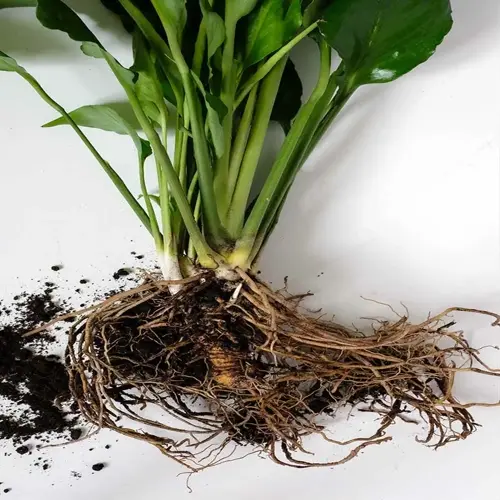
Penn State Extension calls division the easiest way to propagate a snake plant, and it is hard to argue with that. After a few years your plant pushes up offspring at the base called snake plant pups. Those pups grow from the same thick rhizome, the underground stem that all the leaves rise from, so each one already has its own roots and leaves.
That is why snake plant division is also the fastest method you have. Each section you pull off the mother plant behaves like a finished plant from the first day. There is no rooting wait, no callus stage, no soggy cup of water to babysit for weeks. You separate it, you pot it, and it keeps growing.
Last spring I slid a rootbound green Hahnii off the south-facing windowsill and out of its pot, and the roots came out in one dense brick. I brushed the soil back and started dividing snake plants the only way the plant would let me, by teasing the rhizomes apart with my thumbs. One clump near the center would not give, so I took a clean knife and cut straight through the rhizome, turning that single Hahnii into three potted plants. Every one of them kept throwing new leaves without a pause.
Timing helps here. Do your rhizome separation when you repot in spring, since a rootbound plant breaks into clean clumps far more readily than a loose one. There is one rule you cannot skip with variegated cultivars like Laurentii. You must divide them rather than take leaf cuttings, because the yellow edge is a chimera that does not pass through a cutting. Divide it and every new plant keeps the gold.
Slide the parent plant out of its pot and brush away loose soil so you can see the rhizomes and where natural clumps and pups separate.
Locate the offsets, or pups, and the thick underground rhizomes that connect them, since each pup with roots can become its own plant.
Gently pull the clumps apart by hand where you can, and use a clean, sharp knife to cut through any rhizomes that will not separate easily.
Pot each division into well draining mix at the same depth it grew before, then water lightly and place it in bright indirect light to settle in.
All varieties are fairly easy to propagate. My favorite way is to let the plant grow, and then divide them during repotting; this looks the best in my opinion. If you want more plants quicker, you can take leaf cuttings.
Best Conditions For Rooting
The method guides all point back to one thing, and that is the room your cutting sits in. Most articles wave at this with vague advice like warm and bright. The science gives you real numbers, so here is what actually turns a cutting into a rooted plant.
Iowa State Extension lays out the ideal setup in plain figures. Your cutting wants 4 to 6 hours of bright indirect light each day. Keep the air near 65 to 75 degrees Fahrenheit (18 to 24 Celsius). Hold the media a bit warmer at 75 to 80 degrees Fahrenheit (24 to 27 Celsius). High humidity matters just as much, so a clear dome or bag over the pot keeps the air moist. Knowing when to propagate snake plant is simple too. Early spring is the best time to propagate, though any season works fine indoors.
Cold is the one thing that stalls everything. UConn warns that the plant cannot handle temperatures below 55 degrees Fahrenheit (13 Celsius). A chilly room drags rooting to a crawl. NC State notes you should water a mature plant only every 1 to 2 months in winter for the same reason. Growth slows way down when it is cold, so a cutting on a drafty windowsill in January will just sit there.
Think of warmth the way you think of proofing bread dough. Dough barely moves in a cold kitchen, but set it near a warm oven and it wakes right up. A cutting works the same way. A seedling heat mat that holds the media around 75 to 80 Fahrenheit (24 to 27 Celsius) wakes roots up far faster than a cool sill. That warmth is what controls your rooting temperature more than anything else.
High humidity is essential for successful rooting. Cover cuttings with a clear dome or bag, but leave a gap for airflow so moisture does not turn into mold.
New shoots take about 2 months to push up from the base, but that figure is not a fixed countdown. Hit the warmth, indirect light, and humidity above and you land near that mark. Miss them and your cutting can stall for twice as long, so the conditions are what turn that estimate into a real plant.
Variegation And Cultivars
Here is the catch that trips up most people. A variegated snake plant grown from a leaf cutting comes back plain green, with no yellow edge or white stripe at all. If you love the coloring on your plant, the method you pick changes everything.
The reason is a quirk of plant tissue called a chimera. Iowa State Extension explains it plainly. The colored part of the leaf sits in its own outer layer. A leaf cutting regrows from the green tissue inside, so the new plant loses the color the parent had.
Think of the leaf like a layered cake. The colored frosting only sits on the outside, so a slice taken from the middle comes out plain. A leaf cutting works the same way and gives you a green plant. Only division keeps that layered pattern whole. That makes it the one way to retain variegation on prized cultivars like Laurentii.
Snake plants come in more than 70 species, says Penn State Extension. So the right method shifts with the plant in your pot. A tall Laurentii has yellow margins. A dwarf Hahnii bird's nest stays at about 6 inches (15 centimeters). A striped Bantel's Sensation is slim. Each one calls for its own approach, and here is how the popular ones break down.
Laurentii
- Look: Tall upright leaves edged in bright yellow margins, the most popular variegated snake plant in homes.
- Propagation: Divide it rather than taking leaf cuttings, because cuttings regrow all green and lose the yellow edges.
- Why: The yellow margin is a chimera layer, so only division keeps the parent's exact coloring intact.
Hahnii Bird's Nest
- Look: A compact dwarf rosette growing to roughly 6 inches (15 centimeters), forming low clustered crowns.
- Propagation: Divide the rosette clumps, since this dwarf form spreads by pups rather than long leaves.
- Note: Research found Hahnii roots far more readily than the taller Lorentii form in lab conditions.
Bantel's Sensation
- Look: Narrow vertical leaves marked with fine white vertical striping for a striking slim silhouette.
- Propagation: Divide to keep the white striping, as leaf cuttings of this chimera revert toward plain green.
- Use: A good slim choice for tight spots where a wide clumping plant would crowd a shelf.
Moonglow
- Look: Pale silvery green leaves with soft coloring rather than bold edge variegation.
- Propagation: Division is safest for keeping its muted tone, though it is less dependent on a chimera edge.
- Care: Like all cultivars it needs well draining soil and careful watering to avoid root rot.
Cultivars of sansevieria with variegated leaf edges, such as laurentii, lose their interesting coloration when propagated by cuttings.
Troubleshooting Failed Cuttings
One of my water-rooted cuttings wilted and dropped a whole leaf within a week of potting it up on my south-facing windowsill. I pulled back on watering and kept the soil barely moist instead of soaking it. Three days later the plant firmed back up, and the coarse water roots slowly took hold in the dry mix. That slow, gentle handoff from glass to pot is the part most people rush.
Most failures trace back to a handful of plain causes. A soggy medium rots the cutting. A cold or dark spot leaves you with a cutting not rooting for weeks. Skip the callus step and you get a mushy base. The last big one is transplant shock, which hits when water roots to soil is done too fast. Each problem below has a clear fix you can act on today.
Cutting Rotted At The Base
- Cause: The medium stayed too wet, or the cut end never callused, so the soft tissue rotted instead of rooting.
- Fix: Let cuttings dry and callus for a day or two first, and keep the medium only barely moist, never soggy.
- Prevent: Use well draining mix and a pot with drainage holes, since NC State warns that overwatering rots the roots.
No Roots After Weeks
- Cause: The spot is too cold or too dark, slowing root growth far below the expected pace.
- Fix: Move cuttings to a warm spot near 75 to 80 degrees Fahrenheit (24 to 27 Celsius) with 4 to 6 hours of bright indirect light.
- Patience: Even in good conditions, new shoots can take about 2 months, so give it real time before giving up.
Wilting After Transplant
- Cause: Water roots are coarse and adapt poorly to soil, so a cutting can wilt or drop a leaf after potting up.
- Fix: Transplant water cuttings early at about 1 inch (2.5 centimeters) of root, and keep the soil lightly moist while they adjust.
- Prevent: Ease the change gradually rather than moving a long-rooted cutting straight into dry soil.
Cloudy Water And Slime
- Cause: Water sat too long, growing algae and slime that stall rooting and can foul the cut end.
- Fix: Change the water on a schedule, since Iowa State suggests one to two times a week and UConn advises daily.
- Tip: Use a clear glass so you can spot cloudiness early and refresh before it becomes a problem.
The single worst habit is overwatering, and it causes more snake plant root rot than any other mistake. NC State warns that too much water rots the roots, so your cuttings need a mix that drains fast and a pot that lets water escape. When in doubt, give them less water and let the medium dry between drinks.
Fresh water in your jars matters too, though the experts split on the timing. Iowa State says to change it 1 to 2 times a week, while UConn advises a daily swap. Either schedule works, since the real goal is fresh water that stops the slime from stalling your roots. Pick the routine you will actually stick to and your cuttings will thank you.
5 Common Myths
Any leaf cutting from a variegated snake plant will grow into a new plant with the same yellow striped edges.
Variegation comes from a chimera, so leaf cuttings lose the color. Divide the parent plant instead to keep the yellow margins.
Snake plants are completely safe houseplants, so it does not matter if a curious cat or dog chews on a leaf or cutting.
All snake plant species contain saponin toxins and are toxic to pets, so keep plants and cuttings away from cats, dogs, and children.
You should keep a newly potted snake plant cutting constantly wet so the fresh roots never have a chance to dry out.
Overwatering is the top cause of failure. Keep the medium barely moist, because soggy soil quickly rots the cut leaf and new roots.
Water propagation is the best method because you can watch the roots grow and those roots transplant perfectly into soil.
Water roots are coarser and adapt poorly to soil, often causing wilt after transplant. Soil and division usually give sturdier results.
It does not matter which end of a snake plant leaf section you plant, since the cutting will root either way.
Orientation matters. A leaf section only roots from its original bottom end, so planting it upside down means it will never grow.
Conclusion
You now have four proven propagation methods to try. The numbers behind each one came from university extension experts. This is real snake plant propagation science, not guesswork. Division, leaf cuttings, water rooting, and rhizome growth each work. So you can pick the route that fits your goal. The experts back all of them, so you can skip the trial and error most beginners go through.
Keep the anchor figures in mind and your odds shoot up. Cut leaf sections 3 to 4 inches (7.5 to 10 centimeters) long and give them about 2 months to push out new shoots at the base. Hold the air around 65 to 75 degrees Fahrenheit (18 to 24 Celsius) while they root. And if your plant has variegated edges, use division to keep that color instead of cuttings.
The real secret is matching the method to what you want. Divide the plant when you repot it and you get instant, full-sized plants that hold their pattern. Take leaf cuttings when you want to turn one leaf into many new plants over time. Once you know the difference, your propagate snake plant projects start to pay off fast.
One more thing before you start. All snake plant cuttings and plants carry saponins that are toxic to pets, so keep them well out of reach of cats, dogs, and curious kids. The slow early weeks test your patience more than your skill, and patience is the single biggest factor in whether you succeed. These plants are forgiving and hard to kill, so even a first attempt should reward you with fresh new plants.
Glossary
- Callus
- The dry, healed-over layer that forms on a fresh cut, protecting it from rot before roots grow.
- Chimera
- A plant whose tissue is made of genetically different layers, which is why variegated snake plants lose their color when grown from leaf cuttings.
- Dracaena trifasciata
- The current scientific name for the snake plant, a hardy evergreen houseplant once classified as Sansevieria.
- Pup
- A small offshoot plant that grows from the base of a parent snake plant and can be divided off as a new plant.
- Rhizome
- A thick underground stem that snake plant leaves grow from and that can be cut and separated to make new plants.
- Rooting hormone
- A powder or gel containing IBA or NAA that you dip a cutting in to encourage faster root growth.
- Saponins
- Natural compounds in all snake plant species that make the plant toxic to pets and children if chewed.
- Variegation
- The yellow or white markings on a leaf, such as the colored edges on a Laurentii snake plant.
External Sources
Frequently Asked Questions
Is it better to propagate a snake plant in water or soil?
Both work, but soil produces sturdier roots, while water lets you watch progress.
What is the fastest way to propagate a snake plant?
Division is fastest because each piece already has roots and leaves.
How long does snake plant propagation take?
Expect roots in a few weeks and new shoots in about two months.
What are the most common snake plant propagation mistakes?
Common mistakes include overwatering, wrong orientation, and rushing transplants.
How do you propagate a snake plant with no roots?
Place a leaf cutting in water or soil and new roots form from the cut base.
How often should I water a newly propagated snake plant?
Water sparingly, keeping the medium barely moist until roots establish.
Is October too late to take snake plant cuttings?
You can propagate in October indoors, though rooting will be slower.
What helps snake plant cuttings root faster?
Warmth, humidity, bright indirect light, and rooting hormone speed rooting.
How long can a snake plant live in water only?
A cutting can survive months in water, but soil supports lasting growth.
What is the disadvantage of growing snake plants?
Snake plants are toxic to pets, prone to root rot, and slow growing.